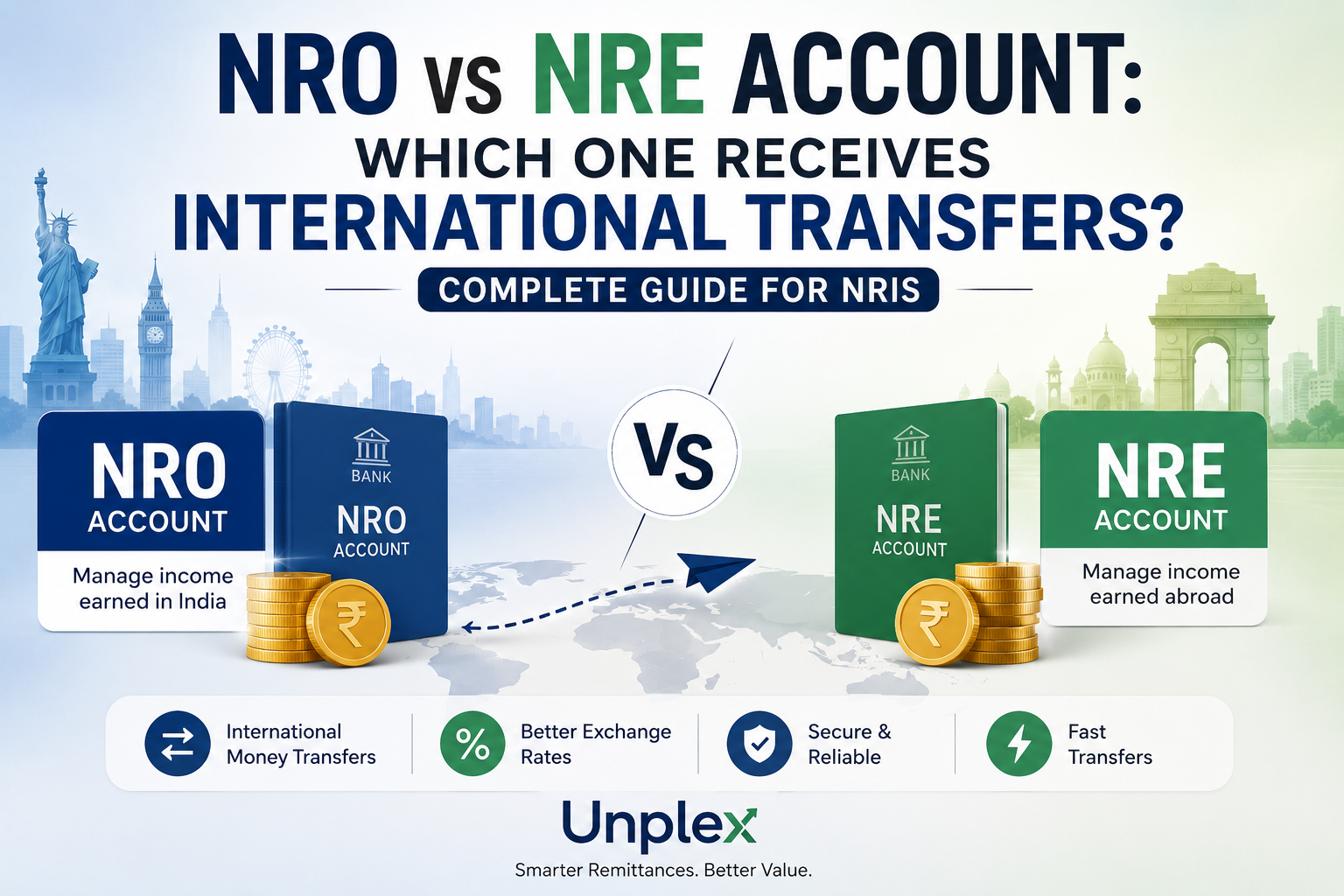
If you’re an NRI managing finances between your country of residence and India, chances are you’ve come across two important banking terms:
- NRO Account
- NRE Account
And one common question continues to confuse many NRIs:
“Which account is better for receiving international transfers — NRO or NRE?”
At Unplex, we work with NRIs across the US, UK, Canada, and Europe who regularly send money to India for:
- Family support
- Investments
- Property expenses
- Vendor payments
- EMIs
- Rental income management
- Daily banking needs in India
While both NRO and NRE accounts can receive international transfers, the actual use case of each account is very different.
And surprisingly, for many real-world NRI use cases, an NRO account often becomes the more practical account for day-to-day India-related financial management.
Let’s understand why.
What is an NRO Account?
An NRO (Non-Resident Ordinary) Account is a bank account designed for NRIs to manage income earned in India.
This includes:
- Rental income
- Pension
- Dividends
- Freelance payments
- Indian salary
- Property-related income
- Local Indian expenses
An NRO account helps NRIs operate financially within India while living abroad.
What is an NRE Account?
An NRE (Non-Resident External) Account is designed primarily to hold foreign income transferred from overseas into India.
The money is maintained in INR after conversion and is generally used for:
- Savings
- Investments
- Fixed deposits
- Wealth management
NRE accounts are popular among NRIs who want tax-free interest benefits and easier repatriation.
NRO vs NRE Account Difference
Here’s a simple comparison:
| Feature | NRO Account | NRE Account |
|---|---|---|
| Primary Purpose | Manage India income & expenses | Hold foreign earnings |
| Tax on Interest | Taxable | Tax-free |
| Best Use Case | India operations | Savings & investments |
| Local Payments | Excellent | Limited practical usage |
| Repatriation | Limited | Fully repatriable |
| Ideal For | Daily India banking | Overseas income storage |
Can NRO Accounts Receive International Transfers?
Yes — absolutely.
An NRO account can receive international transfers from abroad.
In fact, many NRIs actively use their NRO accounts for:
- Supporting family in India
- Paying EMIs
- Property maintenance
- Vendor payments
- Managing Indian subscriptions and bills
- Running local businesses
- Handling rent and local income
This is where the NRO account becomes extremely useful in practical life.
Why Many NRIs Actually Prefer NRO Accounts for India-Related Spending
While NRE accounts are excellent for savings and investments, NRO accounts are often better suited for active India-related financial management.
For example:
Real-Life Use Cases of NRO Accounts
1. Paying Family Expenses
If you regularly support parents or family in India, using an NRO account makes daily operations easier.
2. Managing Property Expenses
Most NRIs who own homes in India use NRO accounts for:
- Maintenance payments
- Electricity bills
- Property tax
- Rent collection
3. Running India-Based Business Operations
Freelancers, consultants, agencies, exporters, and vendors often prefer receiving operational funds through NRO accounts.
4. EMI & Loan Payments
Home loans, insurance premiums, SIPs, and recurring Indian payments are commonly linked with NRO accounts.
NRO Account for Remittance: An Underrated Use Case
A lot of NRIs assume international transfers should only go to NRE accounts.
That’s not entirely true.
If your objective is:
- Active usage in India
- Spending locally
- Paying vendors
- Handling operational expenses
- Supporting family
- Managing recurring obligations
then an NRO account is often the more practical destination account.
NRO vs NRE for International Money Transfers
Here’s the easiest way to think about it:
Use NRE Accounts For:
- Long-term savings
- Investments
- Fixed deposits
- Tax-efficient wealth management
Use NRO Accounts For:
- Local Indian spending
- Family support
- Business operations
- Bill payments
- Rental income management
- Daily banking in India
For many NRIs, both accounts work together.
How Unplex Helps NRIs Transfer Money to NRO Accounts
At Unplex, we’re seeing a growing number of NRIs actively transferring money directly into NRO accounts because of the flexibility they offer for real-world India-related financial management.
Whether users are sending money from:
- USA to India
- UK to India
- Canada to India
- Europe to India
they often use Unplex for:
- Faster transfers
- Better exchange rates
- Zero transfer fees
- Smooth transfers into NRO accounts
- Business and family-related payouts
Why Exchange Rates Matter More Than “Zero Fees”
Many traditional providers advertise “free transfers.”
But hidden exchange rate markups are where users often lose money.
Even a small difference in the USD to INR rate can impact:
- Monthly family support
- Vendor payments
- Rent transfers
- Business expenses
- Property maintenance budgets
At Unplex, we focus on:
- Competitive live exchange rates
- Transparent pricing
- Better remittance value
- Faster delivery timelines
This becomes especially valuable for NRIs making recurring transfers into NRO accounts for active India usage.
Should You Open Both NRO and NRE Accounts?
For many NRIs:
Yes.
A balanced setup often looks like this:
NRE Account
Used for:
- Savings
- Investments
- Foreign earnings
NRO Account
Used for:
- India operations
- Family support
- Bills
- Property management
- Daily transactions
This gives NRIs both flexibility and financial clarity.
Final Thoughts
Understanding the difference between NRO and NRE accounts is important — but choosing the right account ultimately depends on how you actually use money in India.
While NRE accounts are excellent for savings and tax efficiency, NRO accounts are often the backbone of practical day-to-day financial life in India for NRIs.
If your focus is:
- Supporting family
- Paying bills
- Managing property
- Running business payments
- Handling local expenses
then an NRO account can be incredibly useful for receiving international transfers and operating seamlessly within India.
And with platforms like Unplex, NRIs can transfer money into NRO accounts quickly, securely, and at highly competitive exchange rates — without unnecessary hidden costs.
Frequently Asked Questions (FAQs)
Can international money be transferred to an NRO account?
Yes, NRO accounts can receive international remittances.
Is NRO better than NRE for local Indian expenses?
Yes, for many day-to-day India-related payments and operations, NRO accounts are often more practical.
Can I use Unplex to transfer money to an NRO account?
Yes. Unplex supports transfers to NRO accounts across supported corridors.
Is interest on NRO accounts taxable?
Yes, interest earned on NRO accounts is taxable in India.
Which account is better for family support in India?
Many NRIs prefer NRO accounts for recurring family-related transfers and expenses.
Can I have both NRO and NRE accounts?
Yes, NRIs can maintain both accounts simultaneously.
Leave a Reply